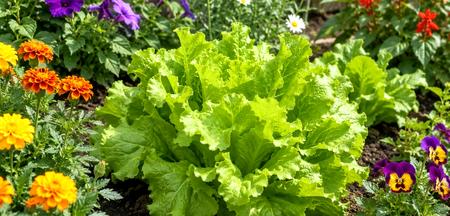


We don't usually think of lettuces as a distinct crop category. We tend to buy lettuce seeds alongside other greens without much distinction. We might pick *Kucheryavets Odessky* or *Gribovsky* for their beautiful ruffled leaves, *Lollo Rossa* because red lettuces are healthy, *Dubachek* because it’s fast-growing and not bitter, or *Moskovsky Parnikovy* because we sow the first batch in a greenhouse or cold frame... Yet, we could just as easily choose varieties like *Aisik*, * Red Byron *, or * Levant *.
Sometimes we pluck the young leaves and wonder why the plant doesn't grow like the store-bought kind—like *Asquith* or *Chin Chin*, for instance.
By the way, store-bought lettuce actually grows back quite well after the leaves are cut; it sprouts new leaves from the center of the rosette and quickly puts on mass.
However, by mid-summer, the leaves often turn bitter and the plant bolts. It wouldn't have to bolt, though, if we used bolt-resistant, all-season varieties like *Maghrib* or *El Leaf*.
We’ve all heard of Romaine , Iceberg, and Frillis lettuces . Have we tried growing them? Well, yes—though it doesn't always work out: sometimes they don't sprout, sometimes they bolt, or sometimes they fail to form a proper head.
Now, however, professional-grade varieties of these lettuce types are available to home gardeners. *Aruba*, *Irwin*, and the mini-Romaine *Kabbura* will delight you with both their shape and flavor.
*El Sammin* is one of the few heat-tolerant Iceberg varieties that forms a crisp head even in summer heat. *El Salada* is beautiful and resistant to bolting.
*El Leaf* (a Frillis type) grows quickly yet offers the crunch of an Iceberg lettuce . It is an excellent choice for market sales. By the way, there are packs containing 250 seeds—instead of just 5 to 20—for the same price.
Looking at these beautiful lettuces, did the thought cross your mind that they could be planted in flowerbeds, not just eaten?