


Breeder Dmitry Sergeevich evaluates the plantings of leaf and head lettuce.
A warm, friendly spring has arrived in the Krasnodar Region, bringing with it a wealth of work at our company's breeding station. Most of the station's plantings are for breeding, requiring evaluation, selection, and variety testing. This is an interesting and painstaking task, where the breeder finds himself in a kind of working "nirvana," evaluating not only the precise criteria of commercial value but also his own experienced instinct.
Lettuces and salads are, of course, the first to arrive. It's a pleasure and a delight to see such a riot of greenery after winter. You're tempted to pinch off a piece of this beautiful lettuce, but you can't—the breeder is strict but fair.
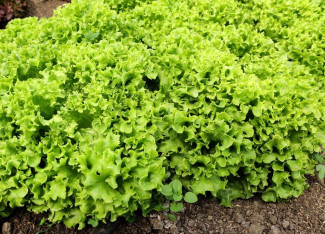
Namur lettuce is a striking example of the Lolla Bionda-type leaf lettuce suitable for winter, early spring, and autumn rotations. It tolerates low temperatures and low light conditions well, gains weight quickly, and is disease-resistant.

Namur lettuce

Trays with coconut substrate and young shoots
In the neighboring greenhouse, a new batch of lettuce is being prepared for planting. Trays of freshly sown seeds are placed nearby. This ensures a constant flow throughout the growing season. Currently, varieties with maximum tolerance to low light, low temperatures, and rot resistance are being selected. Next, the most productive varieties will be screened under near-perfect spring conditions (optimal, low temperatures, high insolation). And finally, the most important test will be for those most resistant to bruising and marginal necrosis in the hot Krasnodar summer.
One of the earliest vegetables to appear in spring is early cabbage. Therefore, breeding this crop is extremely important. Our company has been breeding ultra-early cabbage for several years and will soon introduce hybrid seeds that can compete with the best proven hybrids from other producers.
The process of cabbage hybridization is a long, painstaking process that requires concentration and patience. In nature, cabbage is cross-pollinated by wind and insects, but then, after sowing such seeds, the resulting population is phenotypically heterogeneous. We need plants with strictly defined commercial qualities. The only option is to replace wind and bees by using a pollinator. The most important condition here is complete isolation of the greenhouse from insects flying in from outside.
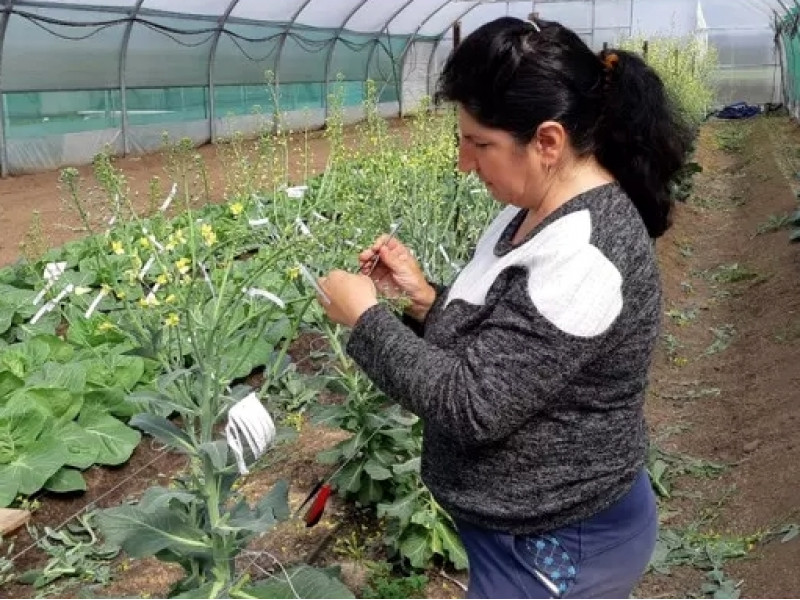
Since cabbage is not a self-pollinating plant, it must be pollinated by humans, strictly during the green bud stage. It is during this period, when the flower is unopened and the pistil is not exposed to light, that cabbage is able to pollinate with its own pollen.

Ultra-early cabbage hybrid

A worker pollinates cabbage using tweezers.