


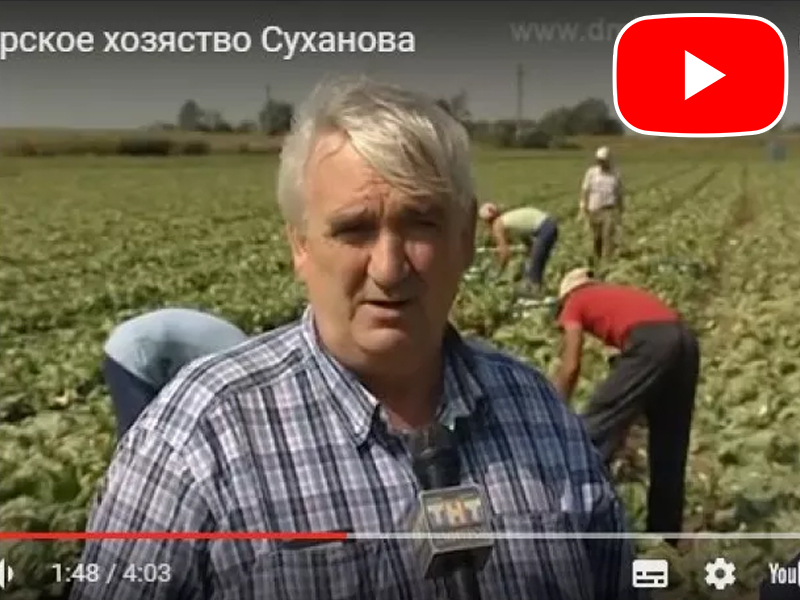
The Sukhanov family farm is now well-known throughout Russia. They were among the first to cultivate various lettuce varieties on the floodplain lands of the Dmitrovsky District of the Moscow Region, a challenging undertaking they have been engaged in for twenty years. Currently, the Sukhanov family farm covers approximately 200 hectares of cultivated land. They grow vegetables such as potatoes, beets, carrots, onions, Chinese cabbage, Savoy cabbage, cauliflower, broccoli, and six types of lettuce, including the popular Iceberg lettuce and Lolla Rossa. According to Pavel Sukhanov, head of the farm, to reduce production costs amid the financial crisis, they are forced to find new solutions, such as using more affordable Russian varieties and hybrids.
The first half of summer was rainy and cold, causing considerable problems for the farmers. Several hectares of cabbage crops were flooded, and cold nights doubled the seedlings' growing season. The losses were significant, but daytime temperatures are now comparable to July, and the losses will be partially recouped.
The plants are generally comfortable in the floodplain, but farmers are currently forced to water their vegetables and salads daily. For this purpose, Sukhanov's farm operates several modern irrigation systems. The heads of salad cut in the field are shipped to customers by truck immediately after harvesting. The farm's distribution system has been well-established over many years: the salads are purchased by the Dmitrov Vegetables agricultural holding, and the vegetables by chain stores. The salad yield reaches up to 20 tons per hectare. Seasonal workers from neighboring regions are involved in the harvest.
Pavel Sukhanov, from the Dmitrov district, does not take commercial loans from banks as a matter of principle; if he needs funds, he borrows from colleagues. He believes that loans in Russia are currently tantamount to robbery. The approach to leasing floodplain lands is also unclear. They are being illegally rezoned from agricultural use to other uses, resulting in the emergence of dachas and illegal peat mining.